

Coins, both ancient and modern, are tough and resilient tangible artifacts of time that carry stories through the ages; made so durable in fact, that they outlast entire empires. Carrying with them messages of hope, strength, and propaganda, they speak tales that will extend past the lives they circulate within.
Join Peregrine Pendants as we go to the start of the first coins and how their stories began.

The Birth of Coinage
In the 7th century B.C., the first true iteration of coins can be traced back to Lydia (what is known today as Turkey). Crafted from electrum, a naturally occurring alloy comprised of gold and silver, these early works started out as irregular, almost bean-shaped stamped disks. This was achieved by taking pre-cut metal blanks and using a prepared punch or die to ensure a consistencey in weight and purity. While not initially ornate in design, the guarantee of such characteristics set the precedent for coins to come.
An iconic example from this era is the Lydian Lion coin, featuring a lion`s head, one of the earliest recognizable state emblems in monetary form. A message of power and strength, paving the way for what was to come.
Greek Innovation: Where Art and Currency Intersect
Known in conjunction with the Romans for their expansion of knowledge and craft, technology, and progression, the Greeks came along and further refined coins. Within the 6th-4th centuries B.C., they had fine-tuned the method of hammered striking.
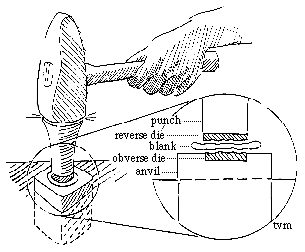
The process, described in detail by Lawrence University’s essays and Warwick’s coin production resources, followed a straightforward method:
-
Metal was melted and refined.
-
It was poured or cut into blanks (flans).
-
The heated blank was placed on a fixed lower die (usually the obverse).
-
A top die was aligned.
-
A worker with a hammer and good aim did the rest.
Often, not a singular person's job, a skilled craftsman was required to keep the base steady, and another to hammer the material. The Athenian owl Tetradrachm (5th century B.C.) and decadrachms of Syracuse were iconic examples of the artistic progression that the Greeks took. These usable sculptures featured messages of art, propaganda, and economic infrastructure that were exchangeable for goods and services; they are among some of the most sought-after relics of the time for modern-day coin collectors (numismatics).
Roman Industrialization
Inspired and influenced by the Greeks, the techniques of crafting coins were taken further. While the technique still involved engraved dies, heated blanks, and hammered force, the Romans organized methods of production to accommodate a rapidly expanding empire. Utilizing an early form of an “assembly line”, the process was made more efficient by workers working in unison, and replacing dies as they degraded.
Iconic Roman examples include:
-
The denarius of Julius Caesar (44 BCE), the first living Roman depicted on state coinage
-
The aurei of Augustus, reinforce the imagery of stability after civil war.
-
The silver denarius of Trajan, celebrates military conquest.
-
The coinage of Marcus Aurelius, demonstrates a philosophical authority and imperial power.
Coins became an effective form of messaging for the empire, with imperial symbolism passing throughout the economy daily.
Over a Thousand Years Later: The Middle Ages
While the process remained the same, centered around blanks and decorated dies, the art style shifted to an arguably less ornate application. Medieval coins such as the English silver penny of Henry II or the Carolingian deniers look less refined than Greek masterpieces, but the technique was fundamentally the same as in classical antiquity.
Often, the cuts would be off, and the strikes would be weak, but fundamentally the same process. These techniques would remain constant until the early modern period, when the craft would change forever.
The 16th Century and a Shift in Craft
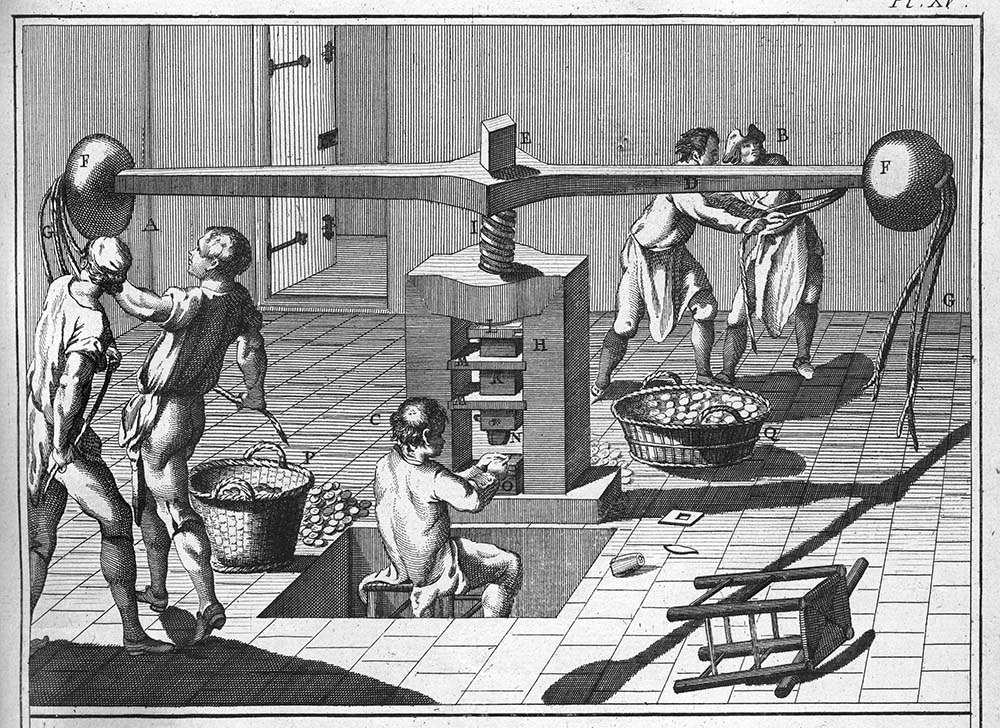
At the turn of the Renaissance period, the old techniques had become too time-consuming and labor-intensive… not to mention prone to replications and forgeries.
As an adaptation, roller mills and screw presses started to replace hand-striking. This new method brought with it more uniformity, even pressure, bringing about a more precise and cleaner end result. This point in time marked the birth of milled coinage, and while still utilizing engraved dies, it no longer relied on brute strength to attain results.
Modern Day Coin Production
Today`s coins are rooted in ancient techniques that would be familiar to a coin worker of the past..however, not at the speed at which we can achieve. Still using dies to impress designs into metal, we have technology now to ensure consistent results.
Modern minting involves:
-
Design modeling (now digitally designed and done with master hubs)
-
Die production using hardened steel
-
Blank preparation from rolled metal sheets
-
High-speed striking using hydraulic presses
The Metropolitan Museum’s collection and educational materials show how die production evolved from hand engraving to mechanized precision. Yet the core remains unchanged: pressure transfers design from die to metal.
A modern press can strike hundreds of coins per minute. The ancients managed one at a time.
Timeline of Coin Production (With Iconic Examples)
|
Period |
Technique |
Iconic Coin |
|
c. 600 BCE |
Early struck electrum |
Lydian Lion |
|
5th Century BCE |
Hammered silver coinage |
Athenian Owl Tetradrachm |
|
4th Century BCE |
Advanced die engraving |
Syracuse Decadrachm |
|
1st Century BCE |
Roman mass minting |
Julius Caesar Denarius |
|
1st–2nd Century CE |
Imperial propaganda coinage |
Aurei of Augustus, Denarii of Trajan |
|
Medieval Period |
Continued hammered production |
English Silver Penny |
|
16th Century |
Screw press & milled coinage |
Early modern milled crowns |
|
19th–21st Century |
Industrialized minting |
Modern national coinage |

Coins as Wearable History
At Peregrine Pendants, we cherish the glimpses into the past in the form of coins. These sturdy, beautiful relics have outlasted multiple empires and crossed through the hands of our ancestors in a deeply personal way. Circulating through time, we take these pieces and hand-set them in beautiful, heirloom works crafted from precious metals that will easily outlast another empire, allowing these whispers of history to tell new tales on you and those who come.
Thank you for joining us here at The Coin Academy.
-Peregrine Pendants
Sources
-
Warwick Classics Network – Coin Production
https://warwick.ac.uk/fac/arts/classics/warwickclassicsnetwork/publicengagement/museums/coins/resources/coinproduction/ -
Lawrence University – Ancient Coin Production
https://www2.lawrence.edu/dept/art/BUERGER/ESSAYS/PRODUCTION7.HTML -
Lam Museum of Anthropology – Ancient Coins: Make Your Own Money
https://lammuseum.wfu.edu/2021/03/ancient-coins-make-your-own-money/ -
The Collector – Ancient Roman Coins: How Were They Made?
https://www.thecollector.com/ancient-roman-coins-how-were-they-made/ -
The Metropolitan Museum of Art – Collection & Coinage Resources
https://www.metmuseum.org/art/collection/search/254990 -
The British Museum – Money Gallery (Room 68) Guide
https://www.britishmuseum.org/sites/default/files/2021-05/Money_Gallery_LPG_2020_Room_68.pdf
Share: