

Marcus Aurelius on a Roman Coin: The Emperor Who Refused to Be “Caesarified”
Few ancient objects bring history as close as a Roman coin. Small enough to rest in the palm of your hand, it once passed through an empire of soldiers, merchants, officials, and ordinary citizens. Its metal carried value, but its imagery carried a message.
A coin bearing Marcus Aurelius is especially compelling. Its portrait presents a powerful Roman emperor, yet his private writings reveal a man deeply suspicious of power’s ability to corrupt him. He commanded armies and governed an empire, but repeatedly reminded himself that the most important form of rule was rule over his own character.
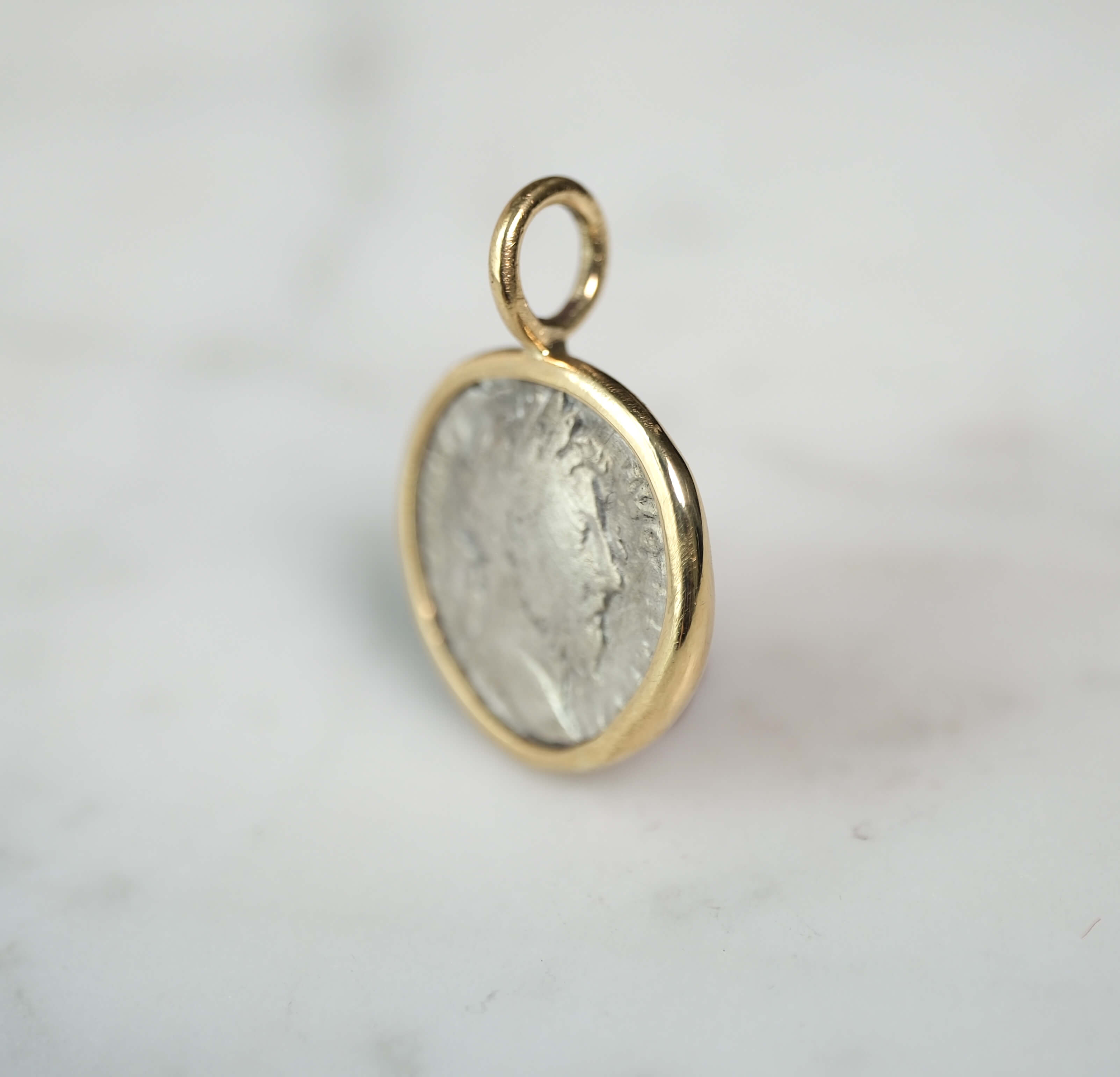
At Peregrine Pendants, we preserve these ancient coins in handcrafted settings, transforming surviving objects of Roman history into jewelry that can be worn and passed on.

Roman Coins Were Messages in Metal
Ancient Roman coins were more than currency. They were miniature works of art and instruments of political communication.
The denarius, one of Rome’s most important silver denominations, was introduced during the Roman Republic and remained in use for centuries. Each coin was struck by hand. A prepared metal blank, known as a flan, was placed between engraved dies and struck to impress the designs into its surface.
Because the process was manual, no two coins emerged exactly alike. Differences in centering, strike, wear, and preservation gave every coin an individual character. The obverse commonly displayed the emperor’s portrait and titles. The reverse might depict a deity, military victory, personified virtue, or political ideal. Images such as Victory, Concordia, and Providentia communicated messages of triumph, harmony, and foresight. These were not merely decorative choices. A Roman coin told its holder who possessed authority, and what that authority claimed to represent.

Who Was Marcus Aurelius?
Marcus Aurelius was born in AD 121 and ruled the Roman Empire from 161 until his death in 180. Until 169, he shared imperial power with his adoptive brother, Lucius Verus.
His reign was shaped by continual pressure. Rome fought major wars on its eastern and northern frontiers, the Antonine Plague devastated communities across the empire, and the revolt of Avidius Cassius challenged Marcus’s authority. Yet Marcus is remembered as much for his inner life as for his imperial career. During approximately the final decade of his life, he kept the private philosophical journal we now call the Meditations.
The work was not written as a modern self-help book or public guide to leadership. Its entries were personal exercises—warnings, reminders, and arguments addressed by Marcus to himself. Scholar Diskin Clay describes them as “Marcus’ exhortations to himself.” That distinction matters. The Meditations do not show an emperor preaching wisdom to his subjects. They show a human being repeatedly working to master his own fear, anger, pride, and appetite.

The Meaning Behind Marcus Aurelius’s Beard
Marcus’s beard is one of the most recognizable features of his portraits, but it was more than personal style. Facial hair carried complex cultural meanings in the Roman world. A beard could evoke maturity, philosophy, ancestral Roman identity, foreignness, or even divinity. Its condition mattered as much as its length. A controlled and carefully maintained beard communicated something very different from hair perceived by Romans as wild or neglected.
Historian Warnock observes: “Roman beards could, and indeed did, become quite long, as in the case of Marcus Aurelius. As long as it was maintained and neat, then it would not have raised much suspicion.”
Marcus’s long but ordered beard therefore reinforced the image of disciplined masculinity. It could identify him with Greek philosophical culture without sacrificing his authority as a Roman ruler. His later portraits may have conveyed another association as well. Some scholars see a “Jupiter-like” quality in them. The full beard could consequently suggest not only philosophical seriousness but also the commanding presence of a god.

The Emperor Who Feared Becoming an Emperor
Marcus possessed enormous power, but his private writings show that he understood its psychological dangers. His most memorable warning to himself is startlingly direct:
“Take care not to be Caesarified, or dyed in purple.”
“Caesarified” appears to be a word Marcus invented. It describes the process of being transformed by imperial power, of allowing status, luxury, flattery, and command to distort one’s character. This gives his coin portraits an unexpected depth. The public image projects stability and control, while the private man behind it warns himself not to become consumed by that image.
Marcus was not rejecting his responsibilities. He continually reminded himself that he was a statesman, a Roman, and a ruler with duties to perform. But he believed that holding an office and being inwardly corrupted by it were two different things. The ruler of an empire was trying not to be ruled by power.
A Philosopher Confronting the Reality of War
Marcus Aurelius is often presented as a serene philosopher, but much of his reign was spent dealing with warfare. Roman forces fought prolonged campaigns against Germanic and Sarmatian peoples along the empire’s northern frontiers.
Rome’s public monuments celebrated these campaigns as demonstrations of imperial victory. The Column of Marcus Aurelius contains scenes of combat, destruction, and the punishment of prisoners. Marcus’s private reflections are far less triumphant. In one unsettling passage, he writes:
“A spider is proud to trap a fly. Men are proud of their own hunting—a hare, a sprat in the net, boars, bears, Sarmatian prisoners. If you examine their motives, are they not all bandits?”
The question exposes a profound tension in his life. Marcus was responsible for prosecuting Rome’s wars, yet he questioned the pride that human beings took in domination and conquest. That contradiction makes him more interesting, not less. The Meditations do not reveal a perfect sage who had escaped moral difficulty. They reveal an emperor attempting to preserve his humanity while exercising power in a violent world.
Marcus Aurelius’s “Inner Citadel”
Marcus believed that genuine freedom depended upon the condition of one’s own mind. Wealth, reputation, physical comfort, and the behavior of others remained partly or entirely outside an individual’s control. Judgment and character, however, could be disciplined.
He therefore returned repeatedly to the idea of an internal refuge:
“No retreat offers someone more quiet and relaxation than that into his own mind.”
This retreat was not an escape from public duty. Marcus remained actively involved in government, military affairs, legal cases, and the administration of the empire. His inward withdrawal was a way to regain perspective before returning to those responsibilities.
Modern scholars sometimes call this mental refuge his “inner citadel.” It was the one territory an emperor could govern completely—provided that he did not surrender it to anger, fear, vanity, or desire. Marcus possessed an empire in the external world. The Meditations record his struggle to establish an empire over himself.
More Than a Portrait
A Marcus Aurelius coin connects two remarkably different kinds of evidence. The portrait shows us the emperor as Rome wished him to be seen: controlled, authoritative, mature, and worthy of command. The Meditations show us the private individual behind that image—a man reminding himself not to be “Caesarified,” questioning the glory attached to conquest, and seeking refuge within his own disciplined mind.
That contrast is what makes the coin so compelling. It does not simply preserve the face of a famous Stoic. It preserves the public identity of a ruler whose private writings reveal how difficult he found the responsible exercise of power.
To wear his portrait is to carry a reminder that outward authority is temporary, but the work of governing one’s own character never ends.
Why Choose a Marcus Aurelius Pendant from Peregrine Pendants?
At Peregrine Pendants, we believe ancient coins should retain the individual character they acquired over centuries.
Each setting is crafted by hand around the coin rather than forcing the artifact into a standardized appearance. Variations in strike, centering, portrait, inscriptions, patina, and wear are preserved as part of the object’s history.
Our pendants:
-
Preserve the character and integrity of the original ancient coin.
-
Pair authentic history with thoughtfully selected precious metals.
-
Respect the individual shape and surface of each artifact.
-
Transform an ancient object into a personal statement, conversation piece, and potential heirloom.
No two ancient coins have followed precisely the same path, and no two finished pendants are exactly alike. By wearing one, you become part of the object’s continuing history. Whether you are drawn to Stoic philosophy, Roman history, ancient craftsmanship, or the tension between power and self-command, a Marcus Aurelius pendant is more than an ornament.It is a fragment of the ancient world and reminder not to be ruled by the things you possess.
Explore our collection of Marcus Aurelius coin pendants and carry a piece of ancient history with you.
Sources
-
Marcus Aurelius, Meditations 4.3, 6.30, and 10.10.
-
Diskin Clay, “Marcus Aurelius: The Empire over Himself,” in The Fall of the Roman Empire: Film and History, edited by Martin M. Winkler.
-
Timothy M. Warnock, Barba: A History of Facial Hair as Cultural Symbol in the Roman World.
Share:
The Romulus and Remus Coin: History, Symbolism & Surprising Facts Behind Rome’s Most Iconic Ancient Coin
Robbing the Tombs of the Pharaohs With Told In Stone